Trail Camera Battery Types: AA, 18650, 21700, Pack & Solar Compared
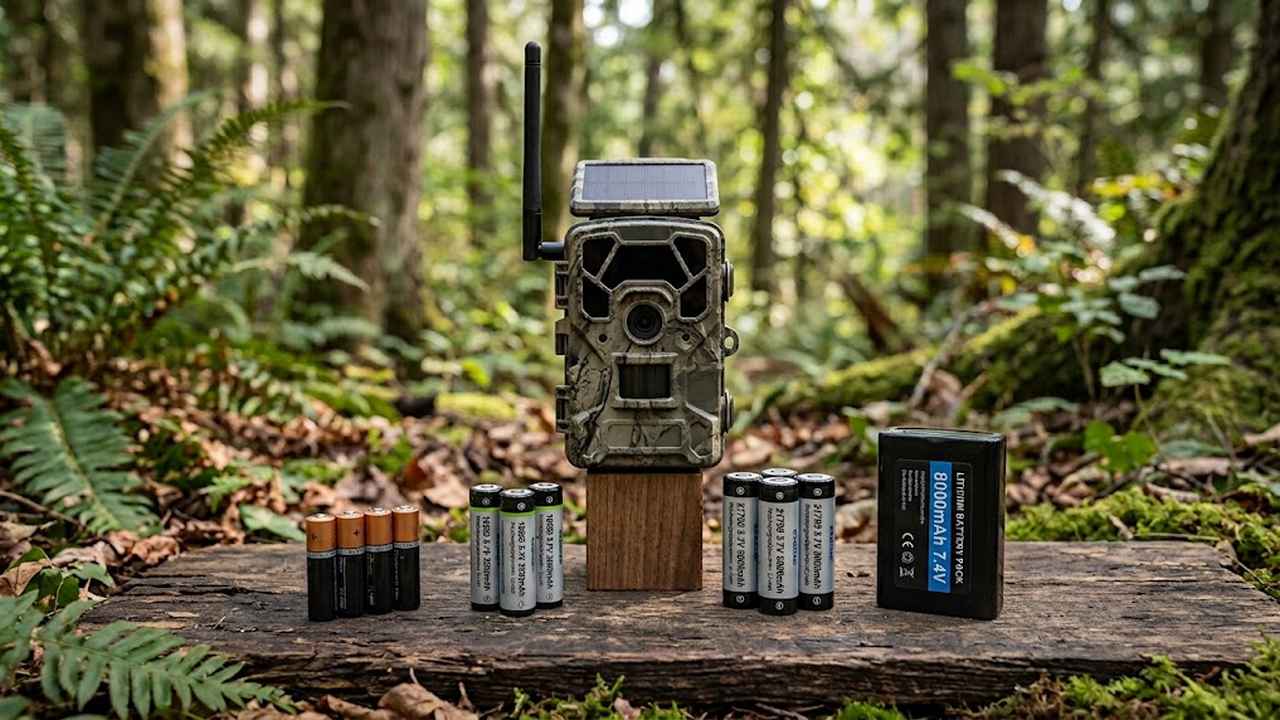
For an OEM/ODM buyer, the battery is not a footnote on the spec sheet — it is the spec sheet. The power source decides the housing shape, the charge circuit, the battery-management logic, how the unit ships (Li-ion carries UN38.3 obligations), how often someone visits the site, and the total cost of ownership over a deployment. A trail camera that picks the wrong cell for its duty cycle is a support ticket waiting to happen, whether it is a cold-climate unit dying in December or a cellular cam sagging under transmit bursts.
Most suppliers, though, hand you exactly two power paths and call it a choice: disposable AA, or a built-in 18650 sealed into the housing. This guide reframes the decision around one word — replaceable — compares the four cell formats that matter, and shows why a swappable architecture changes field service, spare-parts planning and total cost of ownership. Then we show where Xlinkcam's 4G platform sits.
Why most suppliers stop at two power options
The typical trail-camera vendor offers a binary: AA cells (universal, store-bought, but weak under cellular load and cold) or a built-in 18650 (more capacity, but sealed into the housing so that when it ages, the whole camera goes back to the bench). That split is a legacy of bill-of-materials simplicity, not a buyer need. It quietly forces a trade — convenience or capacity, with no middle ground and no field serviceability on the lithium side. A sealed 18650 also turns a $2 cell into a returned-unit repair whenever its cycle life runs out in year two.
The Xlinkcam difference: four swappable formats, one platform
Xlinkcam's 4G trail-camera power architecture is built around user-replaceable cells in four form factors — not a sealed 18650 and a prayer. The same platform accepts the format your deployment actually needs:
- Replaceable AA — keep the universal, store-bought convenience for low-duty or backup use, swapped in seconds anywhere on earth.
- Replaceable 18650 — the cellular workhorse, but in a user-accessible bay instead of a sealed can, so a tired cell is a field swap, not an RMA.
- Replaceable 21700 — roughly 40% more capacity than an 18650, still dropped in and out by hand for longer unattended runs.
- Replaceable large-capacity pack — a high-energy pack in a swappable tray for season-long, hard-to-reach deployments.
The point is not the cell count — it is that the camera never locks you into one chemistry or one sealed battery. When a cell ages, you swap it in the field instead of shipping the unit back. That single design choice ripples through spare-parts inventory, warranty cost and how often a technician drives to a remote site.
Trail camera battery types compared
| Power source | Typical energy | Field-swappable? | Cellular burst | Cold performance | Best fit |
|---|---|---|---|---|---|
| AA alkaline | ~2,500–3,000 mAh/cell (8–12 cells) | Yes | Poor (voltage sag) | Weak below 0°C | Low-cost retail, intermittent use |
| AA lithium (LiFeS2) | ~3,000 mAh/cell | Yes | Better than alkaline | Excellent | Cold climate, disposable convenience |
| 18650 Li-ion | ~2,500–3,500 mAh/cell | Sealed on most brands; swappable on Xlinkcam | Strong | Good | The cellular workhorse |
| 21700 Li-ion | ~4,000–5,000 mAh/cell | Sealed on most brands; swappable on Xlinkcam | Strong | Good | Long-life premium tier |
| Large pack (Li-po) | Varies, high | Manufacturer on most brands; swappable tray on Xlinkcam | Strong | Good | Season-long, remote deployments |
| Solar-augmented Li-ion | Trickle from 2–6 W panel | Internal + panel | Strong | Good | Remote, maintenance-light |
On the Xlinkcam 4G platform, all four primary formats above ship in a user-replaceable bay — the differentiator versus suppliers that seal the 18650 and stop there.
AA — universal, but know its limit
AA cells win on universality: any store sells them, any user swaps them, and there is no charge circuit to fail. The catch is chemistry. Alkaline sags badly under the current spike of a cellular transmit, and its capacity collapses below freezing. Lithium AA (LiFeS2) fixes the cold and holds voltage far better, at a recurring per-shot cost. NiMH is the green rechargeable option but is the weakest of the three in the cold. For a non-cellular or lightly used unit, AA is perfectly rational; for an always-on 4G camera, it is a compromise. Keeping it swappable means you can still carry AA as a field backup even on a Li-ion primary.
18650 — the cellular workhorse, done right
The 18650 is where most modern cellular trail cameras live. At 3.6–3.7 V with 2,500–3,500 mAh, it delivers the sustained current a modem needs to push a photo or clip without the voltage dropping out, and it survives cold far better than alkaline. It is rechargeable, which cuts the recurring consumable cost. The trade-off on sealed designs is that the camera needs a charge circuit, a battery-management system, and a service plan for when the cell ages. Xlinkcam puts the 18650 in a user-swappable bay, so the service plan is "open the latch, drop in a fresh cell" — no bench, no RMA.
21700 — more capacity, still swappable
The 21700 is the same lithium-ion chemistry in a larger can: roughly 4,000–5,000 mAh, about 40% more than an 18650. That extra capacity stretches the time between swaps and pairs naturally with a solar panel for near-maintenance-free operation. It is the premium tier — more energy, slightly more housing volume, a higher bill of materials — and it makes sense wherever the camera is hard to reach or expected to run a long season unattended. Because the Xlinkcam bay accepts the 21700 as a drop-in, stepping up capacity does not mean a different, sealed battery design.
Large-capacity pack — season-long runs in a tray
Some deployments want maximum energy without the volume of many round cells: a custom lithium-polymer or pouch pack shaped to the housing. On most brands that pack is built for one design and replaced only through the manufacturer, so the replacement path has to be specified up front. Xlinkcam ships it in a swappable tray, which keeps the "swap in the field" benefit even at the highest capacity tier — useful for forestry, agriculture and off-grid sites that run a full season between visits.
Solar panels — the mainstream augmenter
Solar does not replace the battery; it feeds it. A 2–6 W panel trickle-charges the internal Li-ion so the camera swaps cells far less often. In practice that means fewer site visits, not zero — a panel mounted in deep shade, under a dense canopy, or facing north will not keep up, and the battery still does the heavy lifting during transmit. The honest framing for buyers is "solar cuts swaps," not "solar eliminates the battery."
There is one structural caveat worth knowing before you spec a solar model. The cable from the panel to the body has to pass through the housing, and keeping that pass-through watertight takes a deliberate feature at the entry point — a molded gland or a sealed boss in the mold. As we covered in our IP67 guide, that change carries a tooling barrier and a cost increase, so many newer entrants skip it and let the body sit at IP66 while the cable joint stays the weak link. For a deployment that depends on always-on solar trickle, that joint is exactly where moisture creeps in over a season. We go deeper on the maintenance story in the maintenance-free solar guide.
How to spec power for your market
Use the duty cycle, not the brochure, to pick the cell:
- Remote, cold, always-on: 21700 plus solar, with field-swap as the service path.
- Cost-sensitive, connected retail: swappable 18650 — best capacity-per-dollar for a connected camera, no sealed-cell RMA risk.
- Disposable convenience or non-cellular: lithium AA; accept the recurring cost for zero charge hardware.
- Season-long unattended: swappable large-capacity pack, sized to the transmit cadence.
- Shipping and compliance: any Li-ion cell carries UN38.3 handling — fold that into logistics from day one.
The power choice also interacts with the rest of the build. A bigger battery tolerates more aggressive trigger and PIR settings; a cellular model's transmit cadence sets the floor on capacity, which is why MMS, SMTP and FTP behave differently in the field; and cellular vs Wi-Fi is partly a power question, because Wi-Fi radios are thirsty. Start from what a cellular trail camera is if the fundamentals are still open.
Where Xlinkcam fits
Xlinkcam builds outdoor cellular trail cameras as an OEM/ODM partner across the five transmission types — MMS, SMTP, FTP, cloud storage, and live stream. On power, the difference versus a typical supplier is the swappable bay: where most vendors ship AA plus a sealed 18650 and stop, our 4G platform offers replaceable AA, replaceable 18650, replaceable 21700, and a replaceable large-capacity pack on one architecture. Because the connectivity, enclosure, and power decisions are made together, the solar-panel cable entry is treated as a rated seal — pushing the build toward IP67 rather than the IP66 most solar models stop at. Specific battery-bay support varies by transmission type and SKU; we will confirm the exact configuration for your model and supply the test reports to back the claim.
Talk to us
If you are specifying power for a harsh or hard-to-reach deployment — forestry, agriculture, remote wildlife, flood-prone or off-grid sites — tell us the duty cycle and the climate, and we will match the swappable cell format, the solar option, and the enclosure rating to it, with the field-service path defined up front. Talk to our team before you lock the BOM.