MMS vs SMTP vs FTP: Which Cellular Trail Camera Fits Your Deployment?
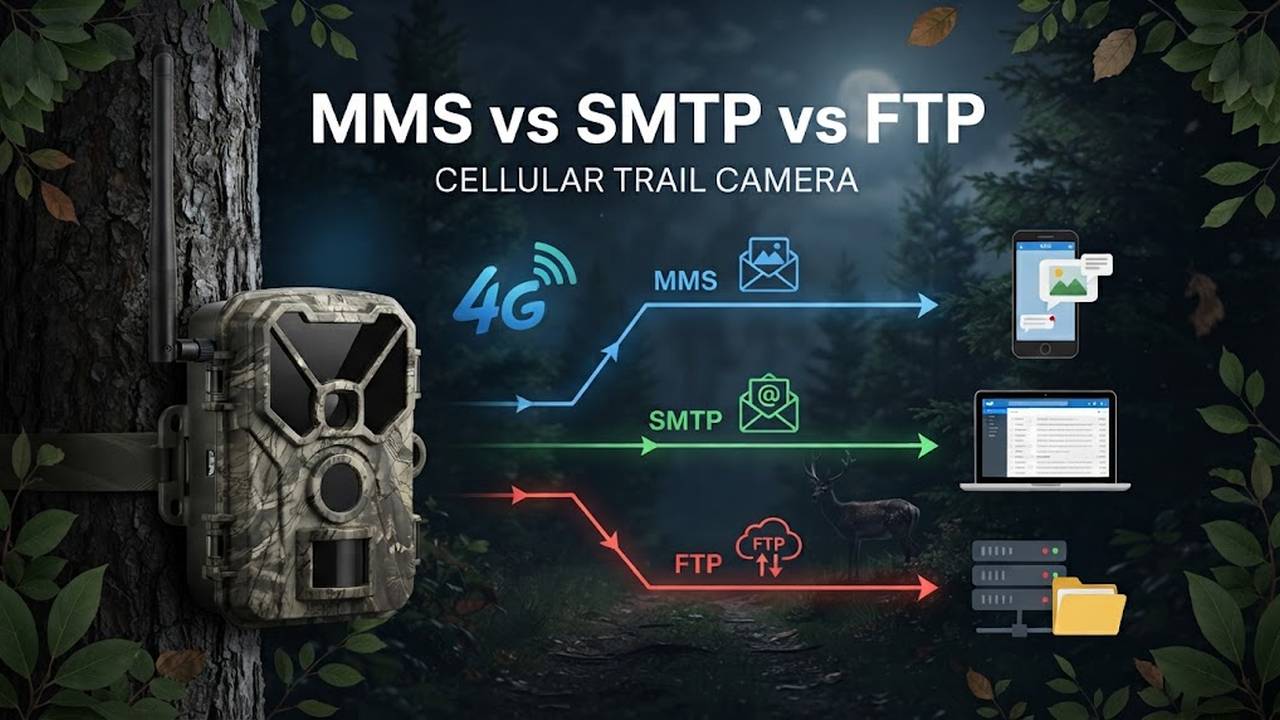
A buyer emailed us recently with a question we hear more often than you'd think: "Do you have this MMS model available? If so, we'd like to order about 100–250 units after we test a sample." That's a serious B2B inquiry — sample first, then volume. And it sits inside a bigger question every OEM, distributor, and property manager should answer before specifying a cellular trail camera: not every "cellular" camera forces you into a SIM card, a monthly subscription, and a mandatory app. There is a whole family of cellular trail cameras that push images out through MMS, SMTP, or FTP — with no cloud platform and no recurring platform fee.
If you're evaluating an MMS trail camera, you owe it to yourself to look at its two siblings: SMTP and FTP. They solve the same "get the photo off the camera without visiting it" problem, but they land differently depending on your market, your IT setup, and how much control you want. Here's the real comparison.
The one thing they share: no subscription lock-in
Most consumer-branded cellular trail cameras — SPYPOINT, Tactacam, Moultrie Mobile, Stealth Cam, Reconyx, Bushnell — require a data plan to function (a paid tier in most cases, a limited free tier in a few). Prices run roughly $5 to $35 per camera per month, the SIM is usually locked to the brand, and you manage everything through the vendor's app. That model works for many hunters. But for an OEM, a distributor, or a manager running camera fleets, recurring per-camera fees and forced apps are a hard sell.
MMS, SMTP, and FTP take the opposite path. The camera uses a standard cellular connection (you supply the SIM and data) and delivers the image to a phone, an email inbox, or your own server. There is no vendor cloud account to create and no platform subscription to renew. You pay only for the cellular data itself.
MMS — the simplest route, and the one with a deadline
How it works: the camera sends the photo to a phone number as a multimedia message. No app, no account, nothing to configure beyond the recipient number. For a buyer who just wants a picture on a phone, it's the lowest-friction option.
The catch — and it's a real one: The MMS trail cameras most buyers meet at the standard tier were built around 2G and 3G modems, and those networks are being retired. In the United States, 2G GSM service ended years ago (AT&T shut it down in 2017) and the major carriers closed their 3G networks by the end of 2022. The European Union is phasing 2G/3G out too, on a country-by-country timeline that runs through the early 2030s. The practical result: a 2G-only MMS camera simply will not connect on most major-carrier SIMs in North America today, and its window is closing in Europe as well.
This matters directly for the model that inquiry referenced. Our MMS Trail Camera (Standard) is a 2G GSM unit — excellent where 2G is still operational, but not a safe bet for a 2026 North-American deployment. For markets where MMS over LTE is still supported, our 4G LTE MMS Trail Camera (Pro) is the forward-compatible choice. Before you commit to MMS, confirm that your target carriers still carry MMS on the bands your camera uses. If you can't, SMTP or FTP will serve you better.
SMTP — email delivery, future-proof on 4G
How it works: the camera emails the photo (and short clips) to an inbox you already check — no app, no cloud account, no subscription. Because it runs on 4G LTE, it isn't exposed to the 2G/3G sunset that's squeezing MMS.
This is a genuinely popular no-subscription route in the European and professional markets. A cluster of specialist 4G cameras — sold explicitly on the promise of "no cloud services, no user accounts, no mandatory apps" — email the image straight to your inbox at full resolution. Many ship with a default sender pre-configured, so setup is often just typing your receive address.
Trade-offs: email can be filtered or delayed depending on the mailbox and carrier, so it's not as instant as a push-notification app. And you're trusting email deliverability rather than a dedicated pipeline. For an SME or a manager who lives in email and wants zero app overhead, SMTP is usually the sweet spot. Our 4G LTE SMTP Email Trail Camera (Standard) and 4G Cellular SMTP 4K Trail Camera (Pro) cover that slot.
FTP — your own server, your own rules
How it works: instead of a phone or an inbox, the camera uploads images to an FTP server you control. That's it — no third-party cloud, no vendor looking at your data, no per-camera platform fee.
Who it's for: enterprises, OEMs, and integrators who are building their own monitoring platform or data lake. If you need to pipe trail-camera images into your own backend, tag them, archive them, or fuse them with other sensors, FTP is the route that keeps you in control. The cost is real IT effort: you stand up and maintain the server, and you own uptime and security.
This is also where the "cellular but no subscription" story meets the "cloud but subscription" story. Our 4G FTP Trail Camera line is the direct-push option for fleet and integration work; if you'd rather we handle the cloud and AI on our side, that's the separate Cloud Storage / Live Stream path (which does carry a platform subscription — a different trade-off we cover in What Is a Cellular Trail Camera?).
Which one fits your deployment?
| If you want… | Choose | Notes |
|---|---|---|
| A photo on a phone, simplest setup, legacy-friendly market | MMS | Verify 2G/3G support in your target market first |
| Images in email, no app, 4G future-proof, SME-friendly | SMTP | Full-res to inbox; watch deliverability |
| Your own storage / platform integration, fleet scale | FTP | Needs server + IT; maximum control |
| Cloud AI + app + managed pipeline | Cloud / Live Stream | Different trade-off: platform subscription |
The honest summary: MMS is the easiest to start but the most exposed to network sunset. SMTP is the balanced default for most buyers who want "no app, no subscription." FTP is the power-user route for anyone building their own system. And if what you actually want is cloud AI and a managed app, that's a different (subscription-based) decision — not better or worse, just different.
The cost question, answered plainly
With MMS/SMTP/FTP, your only ongoing cost is cellular data — a prepaid SIM in the camera, pay for what you use. No per-camera platform fee, no account to renew, no SIM locked to one vendor. Against the subscription cameras that charge $5–$35 per camera every month, the math for a multi-camera deployment is not close.
For OEMs and distributors: spec the protocol to your market
As a manufacturer we build all three protocols as Standard and Pro lines, so you're not forced into one connectivity story. The right move is almost always the one that inquiry buyer is already making: test a sample against your real deployment conditions, then scale. A 100–250 unit order after a sample pass is exactly how B2B validation should work — and it's the fastest way to learn whether MMS still reaches your market or whether SMTP/FTP is the safer bet.
Want the protocol deep-dives or a sample unit for your market? Start with the technology hubs: MMS, SMTP, FTP, or contact us for a sample and a quote.