Bring Your Own SIM, Your Own Server, and Your Own App: What OEM Buyers Ask for in a Cellular Trail Camera
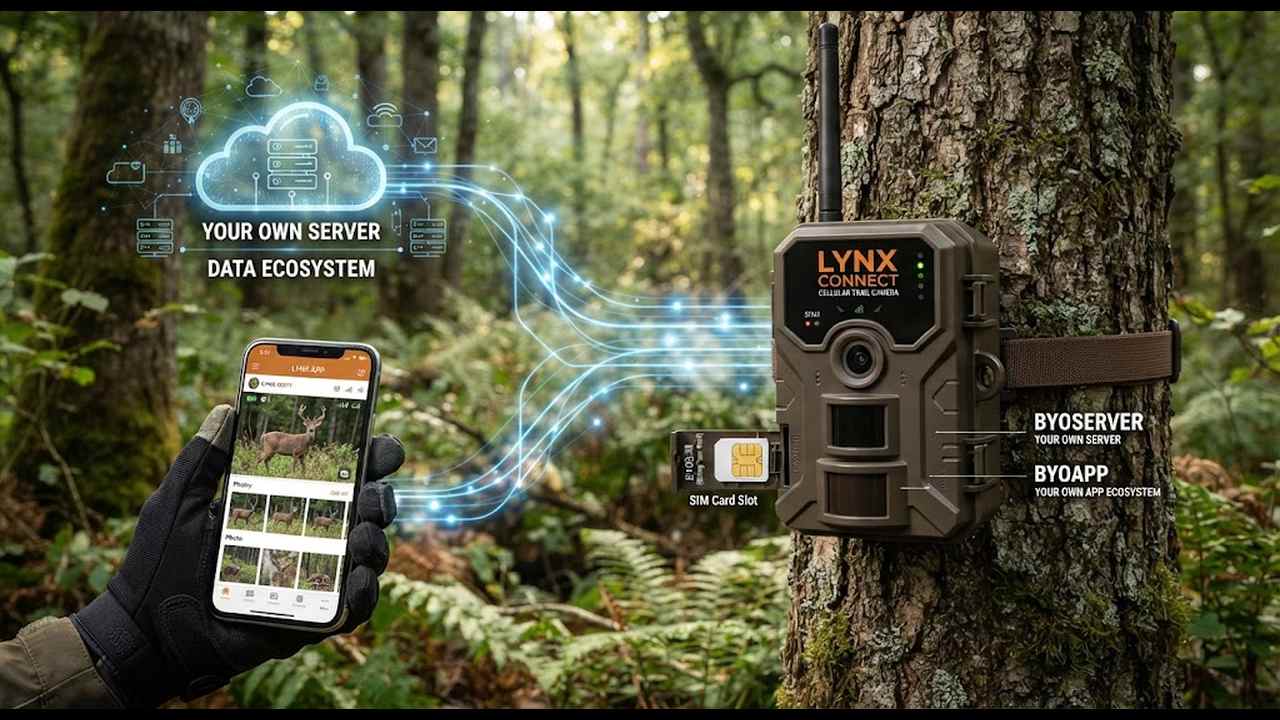
Ask a distributor, a platform company, or a fleet operator what they need from a cellular trail camera, and the same three answers tend to come up before anyone asks about resolution, battery life, or trigger speed. They want their own SIM. They want the images on their own server. And they want their own app in front of the user.
That is not a niche request. It is what happens when a camera stops being a gadget and becomes part of somebody else's product — a hunting platform, a monitoring service, a remote site deployment. At that point the hardware has to disappear behind the buyer's brand and land on the buyer's infrastructure.
This is about those three layers — connection, data, and interface — what handing them over actually involves, and where the honest limits sit.
Why this keeps coming up
Most consumer-branded cellular trail cameras are built around a closed loop: a SIM tied to the brand, a monthly data plan, and an app you have to use. That works fine for someone running two cameras on a lease. It scales badly for a distributor, a platform company, or an operator with a few hundred units in the field.
Three things break. Recurring per-camera fees compound until the subscription costs more than the hardware. The vendor's app sits between you and your customer, so the brand relationship is not yours. And if you ever switch supplier, your fleet, your data, and your user accounts are stranded.
Buyers who have run a fleet for a season have usually worked this out already. They are not asking for a discount. They are asking who owns what.
Bring your own SIM: who owns the connection
This is the layer buyers ask about first, and the easiest to hand over. When you supply your own SIM and data plan, you negotiate with carriers directly, you control billing, and you are not tied to whichever network the camera brand happened to sign with.
What that means in practice:
- Customer-provided SIMs — the camera runs on your card, on your carrier account, under your commercial terms.
- Regional band matching — we fit modules for the regions you actually deploy in, rather than shipping one global modem and hoping.
- Multi-carrier options — where rural coverage is patchy, we can discuss approaches that let the camera use the best network available.
One caveat worth stating plainly: carrier certification is a real cost and a real lead time. We can tell you which certifications our current platforms already hold and which would need to be pursued for your market. Do not assume a modem approved in one region is approved in another.
Bring your own server: who owns the data
The second layer is where the photos go. Buyers with an existing platform rarely want a second cloud to maintain and pay for. They want the camera to behave like a device on their own infrastructure.
| Aspect | What it means | Who asks for it |
|---|---|---|
| API access | A documented REST API, no proprietary mobile SDK required | Platform companies building their own app |
| Direct delivery | Images go straight to your cloud storage or backend | Anyone with an existing ingestion pipeline |
| FTP | Straight to your FTP server, no intermediary | Industrial operators |
| ONVIF | Interoperability with standard VMS platforms | Security integrators |
| Self-hosting | Runs on your own servers or your own cloud account | Data residency and compliance requirements |
| Metadata | Device and image metadata delivered with each upload | Fleet monitoring and diagnostics |
The metadata line matters more than it looks. When you are running a fleet instead of a handful of cameras, knowing which unit is low on battery or sitting on a weak signal is the difference between planned maintenance and a truck roll.
Bring your own app: who owns the interface
The third layer is the one most manufacturers resist, and the one that decides whether a platform company will work with you at all.
We have had buyers state it plainly: their app is the primary interface for setup, image viewing, configuration, and management, and their users should not be pushed into a manufacturer's app with different branding and a second account. That is a reasonable position. If your product is the app, the camera should disappear behind it.
What we hand over:
- Documented REST API — so you can drive the camera from your own iOS and Android apps without adopting a proprietary SDK. Our write-up of a real API integration project shows how far that can go.
- Remote configuration — capture settings, upload frequency, image quality, and scheduling set from your platform rather than ours.
- Local retrieval — where there is no coverage, images queue locally and can be pulled without opening the housing or swapping the card.
- Firmware updates — delivered over the air through your own pipeline.
One caveat: not every buyer needs all three layers. If your requirement is simpler — images to a phone, an inbox, or your own server with no platform at all — our MMS, SMTP and FTP comparison covers that route, and it may save you the platform entirely.
Why "no development fee" is not a slogan
We own our hardware and software platform and the team that builds it, which changes the economics of custom work. Our existing platform already covers more than 80% of the requirements we see in typical OEM briefs. Most projects need adjustments, not redevelopment.
That is why we do not charge a software development fee on OEM orders. The commercial structure is simple: once an evaluation sample is confirmed and a production order is placed, the function adaptation is handled as part of the project rather than billed as NRE.
Two honest limits, because overpromising here is how projects go wrong:
- Some features still need firmware work. A request like GPS timed-interval auto-reporting is a small adjustment rather than a rebuild, but it is not zero. We will tell you which bucket your requirement falls into before you commit.
- Hardware-level requirements are a separate conversation. Hazardous-location certification, extreme operating temperatures, or a multi-year battery target depend on the enclosure, the cell chemistry, and the certification path. A software platform does not solve those. We will tell you what is achievable, what needs a modified build, and what is out of reach at your volume.
What to send us first
The inquiries that move fastest arrive with enough detail to quote against. The useful set is short:
- Where the cameras will operate, and which carriers matter
- Whether you supply the SIM and the server, or need us to
- Your interface expectations — your own app, ours, or none
- The volume steps you actually plan to buy at
- Any environmental or certification requirements beyond the usual outdoor rating
Our cloud-storage and live-stream lines are usually the starting point for platform-integration projects.
If you are evaluating a platform rather than buying a product, start with samples and test the parts that are hardest to fake: real coverage on your carriers, offline behaviour, local sync, and how your app actually talks to the camera. Send us the brief and we will tell you what the current platform already does and what it would take to close the gap.