The stealth question every buyer eventually asks
Most trail-camera buyers do not start by asking about infrared. They start by asking a simpler thing: will the animal see the flash? That single worry is what puts "no-glow" and "low-glow" at the top of every spec sheet. Both are infrared night modes, both are invisible to human eyes in the daytime, and both shoot in black-and-white at night. The difference is one number: the wavelength of the LEDs.
This guide is about that number, what it costs you in range and budget, and how to pick between the two when you are specifying a model for your own brand. If your real question is color night vision rather than stealth, that is a different topic — we cover it in our full-color trail camera guide.
What "no-glow" and "low-glow" actually mean
Trail cameras see in the dark by lighting the scene with infrared LEDs the human eye cannot see well. Two wavelengths dominate the market:
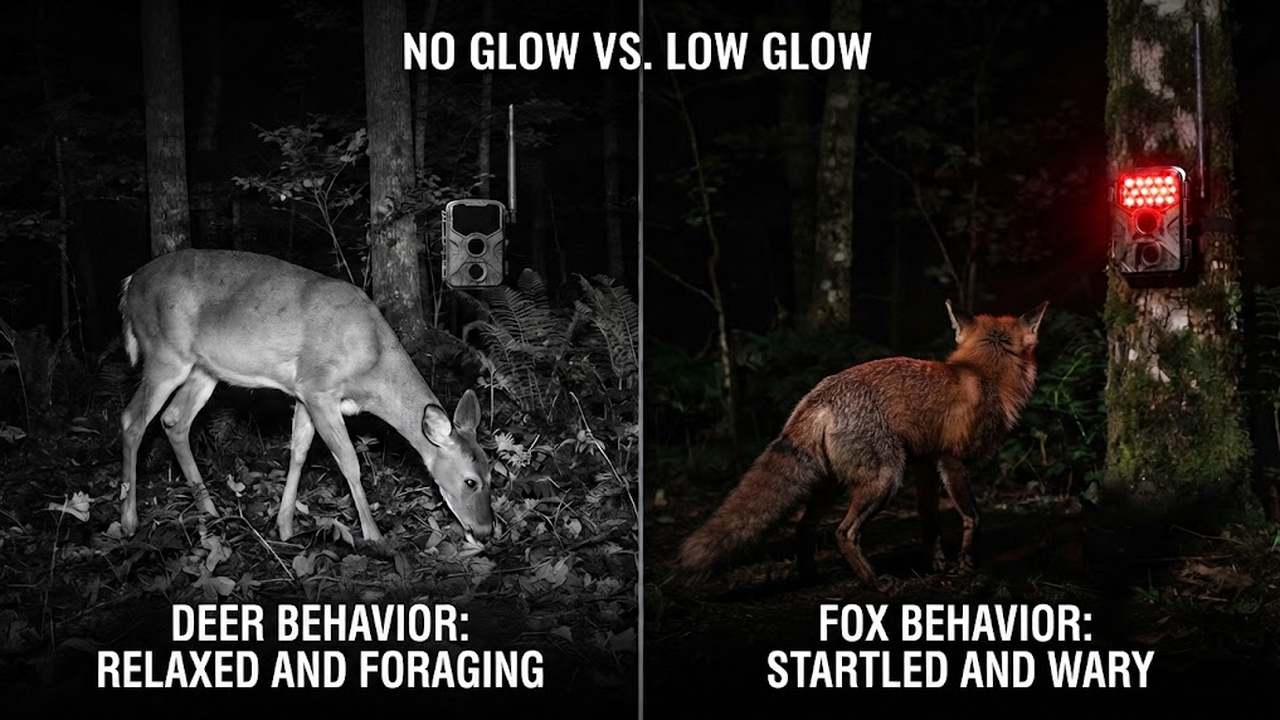
- No-glow (940nm). A longer wavelength. To a person — and to most mammals — the emitter shows no visible red dot at all. The camera is, for practical purposes, dark.
- Low-glow (850nm). A shorter wavelength. It is still "invisible" in the sense that it is not a white flash, but a faint red glow is visible if you look straight at the lens up close, especially on a dark night.
Neither is a "flash" that freezes the frame like an old point-and-shoot. Both are steady infrared illumination. The only real question is how much of a tell-tale red dot the camera leaves behind.
The reason wavelength matters is basic human biology: the eye stops seeing red somewhere around 700nm, and sensitivity drops off fast after that. At 850nm a dim red glow still lingers; at 940nm it is effectively gone. Cameras do not care — both wavelengths light the scene well enough for a clean monochrome image — so the trade-off is purely about what a watcher can perceive, not about picture quality.
Where the two actually diverge
The wavelength choice is a set of trade-offs, not a quality ranking. Here is what changes:
- Visibility. No-glow leaves no red dot. Low-glow leaves a faint one that a person standing at the camera could notice.
- Night range. 850nm throws light a little farther and a little brighter per LED, so low-glow units typically reach a few metres beyond a no-glow unit at the same LED count.
- Battery draw. Close enough to call equal; both are far cheaper than a white flash. LED type is not where your battery budget goes.
- Cost. 940nm LEDs cost a bit more and need more of them to match 850nm reach, so no-glow models carry a small premium.
No-Glow vs Low-Glow: the comparison
| Factor | No-Glow (940nm) | Low-Glow (850nm) |
|---|---|---|
| Visible red dot at night | None — fully dark | Faint, visible up close |
| Effective night range | Good | Slightly longer per LED |
| Battery impact | Low | Low |
| Component cost | Higher (more LEDs) | Lower |
| Best for | Anti-poaching, research, security | Hunting, general scouting |
When low-glow is the smarter buy
If the camera sits on your own land, on a fence line you drive past, or in a hunting lease where no stranger is studying the unit, the faint red dot of 850nm rarely matters. What you get instead is a little more reach and a lower bill — the same stealth in practice, with margin to spare on range. For high-volume, price-sensitive SKUs, low-glow is often the rational default.
When no-glow is worth the premium
The moment exposure matters, 940nm earns its cost. Anti-poaching patrols, wildlife research where a visible emitter could change animal behaviour, and site security where someone might disable a camera they can see — those are the cases where "fully dark" is not a nice-to-have, it is the spec. If your buyers operate in any of those contexts, no-glow is the right answer and the premium is small relative to the risk it removes.
The market reality: stealth is a maturity signal
Here is the part spec sheets skip. A lot of new factories do not actually ship true 940nm. They fit 850nm — or a "940nm-class" emitter that still leaks a visible red dot — because those LEDs give brighter, longer night vision for the money. The trade is exactly the one this guide warns against: better pictures, worse stealth. It works, because their buyers are mostly in home-security and property-defense use cases, where a faint glow on your own fence line is a non-issue.
But hunting buyers care about the opposite thing. In the field, a visible emitter is the difference between a camera that watches and a camera that gets spotted, studied, and walked around. Earning true 940nm with strong night reach is not a checkbox — it is years of optical and firmware tuning that established hunting-camera manufacturers have accumulated. That is why the cameras that vanish completely at night tend to come from suppliers who have spent a decade in the hunting segment, not from a generic electronics trader that added a trail camera to the catalogue last year.
Communication tells the same story. The hunting field is where trail cameras learned to talk back — first by MMS, SMTP and FTP, pushing images out over cellular without anyone touching the SD card. Mature hunting OEMs ship all of those plus cloud and live-stream; newer entrants usually ship only cloud storage, because building reliable MMS/SMTP/FTP pipelines is harder than pointing a camera at a cloud bucket. So when a "trail camera" offers cloud alone, it is often a signal that the supplier is new to the hunting workflow, not that cloud is the better design.
How to spec it with your OEM
The wavelength is only one line on the build sheet. When you talk to a manufacturer, the questions that actually move the result are:
- LED wavelength — 940nm or 850nm? Decide per model, not per brand.
- LED count and beam spread. Reach comes from count and optics together, not wavelength alone.
- Is the IR-cut filter switched automatically? A proper day/night cut keeps color by day and clean mono by night.
- Can the same housing carry either LED type? Good OEMs tune this per project rather than forcing one answer.
Our OEM/ODM buyer's guide walks through the wider set of questions — MOQ, certification, lead time — that sit around this one.
Where Xlinkcam fits
We are one of those established hunting-camera manufacturers — sixteen years in the segment, building for brands that resell into hunting, research and security. That is why our MMS, SMTP, FTP, cloud and live-stream lines all ship 940nm no-glow as the standard night mode: covert monitoring is what our B2B buyers actually ask for, and we have the optical and firmware depth to keep night reach strong while the emitter stays dark. LED count and wavelength are spec items we tune per OEM project, so a distributor can launch a no-glow flagship and a low-glow value model from the same platform. If you are weighing connectivity alongside night mode, our cellular trail camera explainer covers how the two choices are independent: IR type is a lighting decision, not a transmission one.
For concrete models, the no-glow positioning shows up across the range — from the MMS line and FTP line to the live-stream line. The night mode is a constant; the connectivity and price tier are what change.
Choosing for your market
If your customers monitor their own property, low-glow gives you range and margin with no real downside. If they operate where a camera must disappear — research, security, anti-poaching — pay the small premium for no-glow and say so in the listing. The right answer is almost never "one mode for every SKU"; it is "match the LED to the threat model," then let the rest of the spec follow.
Talk to us
Specifying IR wavelength is the easy part of a build; matching it to your market, your certification path and your price tier is where we help. Talk to our team about a no-glow or low-glow model on the platform that fits your brand — wildlife monitoring and hunting programs both start from the same conversation.