How AI Is Reshaping the Trail Camera Industry in 2026
How AI Is Reshaping the Trail Camera Industry in 2026
A plain look at what edge AI actually changed in trail cameras this year, why it matters more for brands than for specs, and how Xlinkcam builds AI-capable cameras while leaving the software stack — and the business model — to its clients.
For two decades a trail camera was a box that snapped a picture when something warm moved. In 2026 the interesting part is no longer the megapixels or the flash range — it is what the camera does with the image before it ever leaves the device. High-end models now carry a dedicated neural processor that runs computer vision on the camera itself, with no cloud round-trip. The industry has started describing these units not as cameras but as field assistants: detect, classify, filter, and decide in the field. This is edge AI in the literal sense — the model runs on the camera, not in a data center. As a cellular trail camera manufacturer shipping to distributors and integrators, that shift changes the product brief entirely — and it is the angle this article is written for.
From Specs to On-Device Intelligence
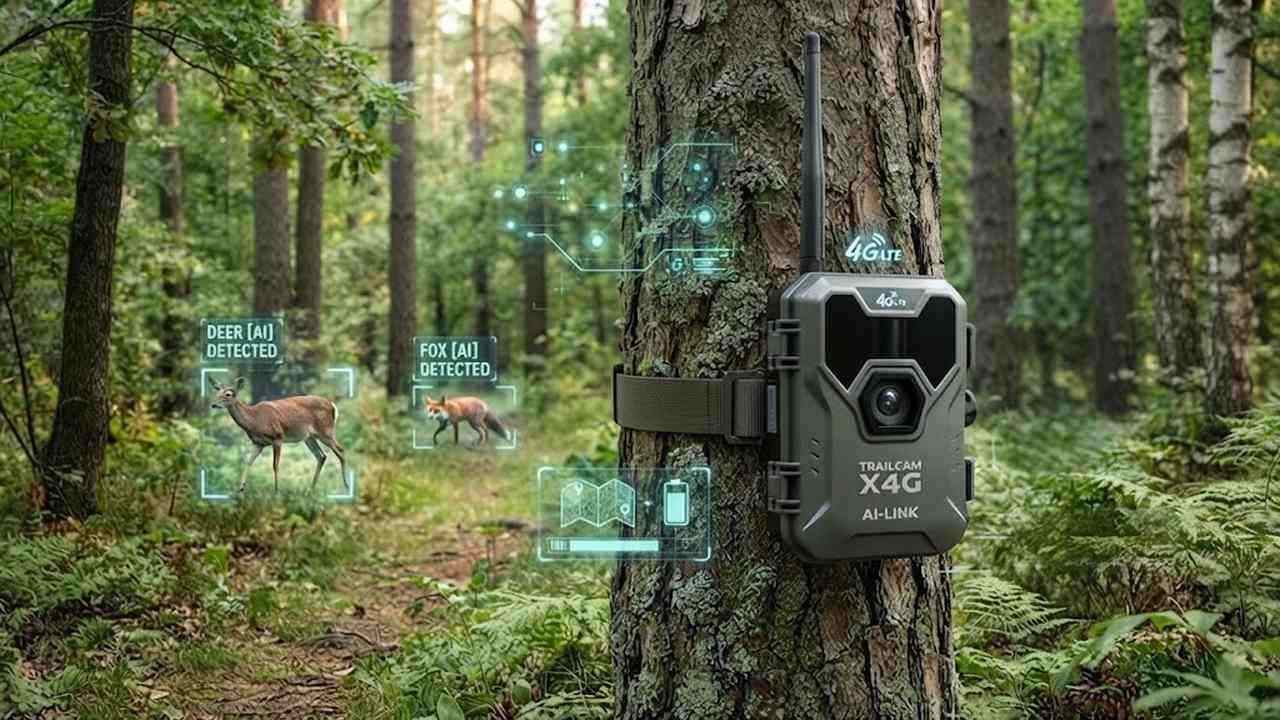
The clearest change is recognition moving to the edge. The camera classifies deer, predator, person, or vehicle right there in the field and tags the frame before it is sent — the on-device AI trail camera does exactly this, with no cloud round-trip. For a research or conservation team, species-level counts come straight off the device instead of from a contractor clicking through ten thousand photos. The nights spent sorting empty frames disappear, and the data is structured the moment it is captured, not after a human babysits it.
This is not a niche upgrade. The cellular game-camera market was valued at about USD 155 million in 2025 and is forecast to reach roughly USD 280 million by 2032 (CAGR ~8.8%), with North America the dominant region and hunting the leading application. As competition moves from "which sensor" to Connectivity × Energy Autonomy × On-Device AI × Customizability, the brands that win are the ones bundling a complete field operating system — hardware, app workflow, AI filtering, and power — not the ones with the highest resolution.
False Triggers: The Problem AI Actually Solves
PIR sensors have always been fooled by wind, rain, and shifting shadows. AI tells a branch from a body and refuses to record the noise. On a connected camera this pays twice: the SD card is not clogged with junk, and the SIM is not billed to send it. Vendors running field deployments report false-trigger reductions in the 85–95% range once on-device filtering is on — and a camera that transmits only real detections also lives longer on a battery and keeps the human on the other end paying attention instead of crying wolf. For a commercial deployment, that last point — relevant alerts instead of noise — is the difference between a tool people use and a tool people mute. We do not quote a lab figure that field conditions will not match; we tune the recognition profile to your region and your species instead of shipping one global model and hoping. The on-device AI trail camera ships this filtering as a standard capability, so partners start reducing false triggers out of the box.
What It Means for the Buyer's Workflow
Picture a grid of units across a reserve or a ranch. Without on-device AI, a technician collects cards, a lab uploads them, and contractors spend days tagging species — results lag the field by weeks. With it, each frame is tagged at capture; the reviewer sees only the detections, and the count is current within hours. Landowners and game managers review live views from the app instead of hiking out. Security integrators have quietly turned the wildlife camera into a low-maintenance perimeter sensor, because the underlying problem — detect the right thing, ignore the rest — is identical.
AI Also Improves the Picture Itself
Filtering is only half of what changed. A trail camera lives in the worst light a sensor will ever face — predawn, dusk, deep shade under canopy. On-device AI now does computational photography: it lifts detail out of near-black frames, suppresses sensor noise, and can upscale a soft capture into something you can actually identify. So AI is not only deciding whether to send a frame; it is improving what the frame shows. For a wildlife or farm user, that means a usable image from a shot that used to be throwaway noise — another reason the value of the camera moved from the lens to the model.
Where the heavy lifting moves to the cloud, the gains go further. Server-side models upscale, denoise, and can AI colorize night-vision footage into natural-looking color — the basis of our cloud AI trail camera. Cloud colorization is an AI-enhanced approximation, not a true-color capture, so we label it plainly; genuine full-color night vision still comes from the starlight sensor. Either way, AI now improves what the frame shows, not just whether it is sent.
Where Most AI Cameras Actually Stop
Walk the product listings in 2026 and a lot of the "AI" on offer is a label, not a capability. Many brands ship recognition that cannot even name the species — it sorts "animal" and stops there. The accuracy is weak enough that users stop trusting the alerts. And the image quality is no better than the pre-AI generation, because the same old sensor pipeline is still doing the work.
The reason is where the effort goes. When a maker's business is built on selling data plans and subscription tiers, the camera is the hook for the recurring revenue — so the AI on it only has to look modern in the listing, not actually work in your field. That is the same pressure we described in our piece on the subscription model: when the margin lives in the plan, the product stops being the point.
We carry no such burden. Our years of scenario customization — shaping cameras to real farm perimeters, wildlife reserves, and security sites — left us with exactly what the AI era rewards: field data and the engineering discipline to use it. That history now pays off twice over: the same muscle that tuned a camera to one client's land now tunes the model to their animals, and the same freedom from a subscription business lets us spend our energy on the camera itself.
Where Xlinkcam Fits
We started AI R&D in 2022 and began ramping production orders in 2025. That timing matters: we did not bolt AI on as a marketing add-on, we designed it into the platform while the market was still arguing about cloud versus edge.
We build AI-capable cellular trail cameras in two lines — the on-device AI trail camera (recognition and false-trigger filtering at the edge) and the cloud AI trail camera (server-side enhancement and AI colorized night vision) — with free cloud storage as the baseline and economical data plans, because that is what the market now expects. For our OEM/ODM partners, the point is that you set the terms: the data plan, the cloud, the app, and the server are yours to define. That is the same principle behind our subscription-model stance — the business model stays with the partner, not with us.
The differentiator is depth, not features. We have spent years in two fields most camera makers only visit: farm protection and wildlife observation. That time shows up as proprietary training data — real animals, real ranges, real seasons. On the back of that accumulation and our engineering edge, we are putting our effort into three things:
- Species recognition — more classes, higher accuracy. Models tuned on years of field captures from the environments our customers actually deploy in, not a handful of stock photos that mislabel a moose as cattle.
- AI that lifts image quality. On-device computational photography that recovers detail from low-light and noisy frames, so the picture itself gets better, not just the filtering.
- Reports that understand the customer. Insight output shaped to the buyer's operation — counts, patterns, and alerts they can act on — instead of a raw dump of photos.
The connectivity and on-device architecture underneath are spelled out on our technology page, and the management platform that turns detections into your backend workflow is covered in our API guide.
Limitations, Stated Plainly
AI identification is not infallible, and anyone selling it as such is setting you up. Most off-the-shelf AI still stops at coarse classes — person, vehicle, animal — and stumbles on species or on animals at the edge of range. Accuracy depends on the trained profile and on conditions: heavy mist or an animal at distance will occasionally be misread. We set expectations during specification instead of over-promising, and we tune the recognition profile to your region rather than shipping one global model and hoping. Honesty here protects your brand when your customer's customer notices a misread.
Off-the-Shelf AI Camera vs. an Xlinkcam OEM/ODM AI Camera
| Aspect | Off-the-shelf AI camera | Xlinkcam OEM/ODM AI camera |
|---|---|---|
| Intelligence location | Cloud- or app-dependent | On-device, edge AI |
| False-trigger handling | Vendor-defined | Tuned to your use case |
| Recognition profiles | One global model | Per-region / per-species tuning |
| Species recognition accuracy | Coarse, general classes | Trained on years of farm + wildlife field data |
| Image quality | As captured; noisy in low light | AI-enhanced, low-light recovery & upscaling |
| Insight output | Raw photo dump | Customer-shaped reports, counts & alerts |
| App & cloud | Vendor's, locked | Your brand, your server |
| Data residency | Vendor's cloud | Your control |
| Roadmap control | Set by the brand | Set by you, the client |
| Margin for the partner | Middleware takes it | Stays with you |
Building AI That Fits Your Market
If you are weighing an AI trail-camera program, the real question is not "does it have AI" but whether that AI is built for your field — or just printed on the box. That distinction is exactly what we obsess over.
Tell us your market, your species, and how you want the data to move — cellular, MMS, or SMTP — and we will scope an on-device AI camera around it: recognition tuned to your region, image quality recovered in low light, and reports shaped to your operation. Talk to us to see what an AI-capable, CE-RED certified program from Xlinkcam looks like with your brand on it.